Overview
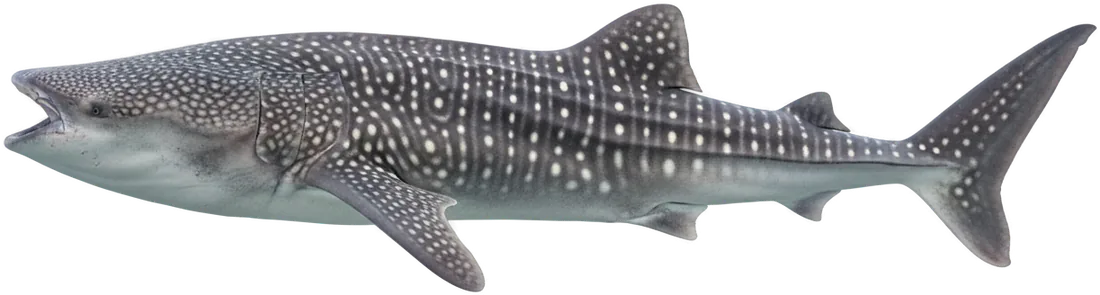
The whale shark is the largest fish in the world, but do not let its size scare you. It is a slow, peaceful giant that eats some of the tiniest food in the sea. Its wide, flat head ends in a huge mouth that can be over a meter across, and its dark skin is covered in a beautiful pattern of pale spots and stripes. Just like human fingerprints, no two whale sharks have exactly the same pattern, so scientists use the spots to tell individuals apart.
Even though it is called a whale shark because of its whale-like size, it is a true shark and a true fish, not a mammal. It cruises slowly through warm oceans with its mouth open, straining plankton and other tiny creatures from the water. Divers and snorkelers travel from all over the world to swim alongside these gentle giants, being careful to look but never touch.
| Where it lives | Warm open seas and coastlines where plankton blooms |
| Range | Tropical and warm oceans worldwide, seen off Australia, Mexico, the Philippines, and East Africa |
| Adult size | Commonly 18 to 33 ft (5.5 to 10 m), with rare giants even larger |
| Diet | Plankton, tiny fish, fish eggs, and other small drifting animals |
| Lifespan | Estimated 80 to 130 years |
| Depth or habitat | Warm surface waters, but can dive well over 1,000 m |
| Keep at home? | No, the largest fish on Earth and far too big for any home |
A gentle giant
Whale sharks can grow longer than a school bus, yet they are completely harmless to people. They have no interest in large prey and their throats are quite narrow, so they simply cannot swallow anything big. Their enormous size and calm, unhurried swimming make them one of the most amazing animals a diver can ever meet in the wild.
Filter feeding
Instead of hunting, a whale shark eats by filter feeding. It swims forward with its mouth wide open, or sometimes hangs upright at the surface gulping water, then pushes the water back out through special sieve-like pads in its gills. The tiny plankton, fish eggs, and little fish get trapped and swallowed while the water flows away. A big whale shark can filter a huge amount of seawater every hour this way.
Spot patterns like fingerprints
Every whale shark wears a unique pattern of white spots and lines across its back. Researchers photograph these patterns and use computer software, originally designed to map stars in the night sky, to recognize individual sharks year after year. This helps scientists learn where whale sharks travel, how fast they grow, and how long they live, all without harming the animal.
Why they gather
At certain times of year, dozens of whale sharks show up in the same place to feast on sudden explosions of plankton or clouds of fish eggs. Famous gathering spots include Ningaloo Reef in Australia and the waters off Mexico. These meetups are some of the best chances scientists get to study them, and some of the best chances travelers get to swim beside them respectfully.
A species at risk
Whale sharks are endangered. They grow and reproduce slowly, and they are threatened by fishing, by being struck by boats, and by pollution. Because they swim across international waters, protecting them takes cooperation between many countries. Many places now run tours with strict rules so people can enjoy the sharks without hurting them.
Fun facts
- The whale shark is the largest fish in the ocean, bigger than any other fish alive.
- Its spot pattern is unique, like a fingerprint, and scientists use star-mapping software to identify individuals.
- It eats by filtering tiny plankton, not by biting large prey.
- A whale shark's mouth can be over a meter wide.
- Scientists think whale sharks may live to be over 100 years old.
Frequently asked questions
How big is a whale shark?
Most are about 18 to 33 ft (5.5 to 10 m) long, and a few grow even bigger, making them the largest fish on Earth.
Is it dangerous?
No. Whale sharks are gentle filter feeders that eat tiny plankton and are harmless to people, though you should always keep a respectful distance.
What does it eat?
Plankton, fish eggs, and small fish, which it strains out of the water through its gills.
Is the whale shark a whale?
No. It is a true shark and a fish. It is only called a whale shark because it is as big as a whale.
Are whale sharks endangered?
Yes, they are listed as endangered, so many countries work to protect them from fishing and boat strikes.