Overview
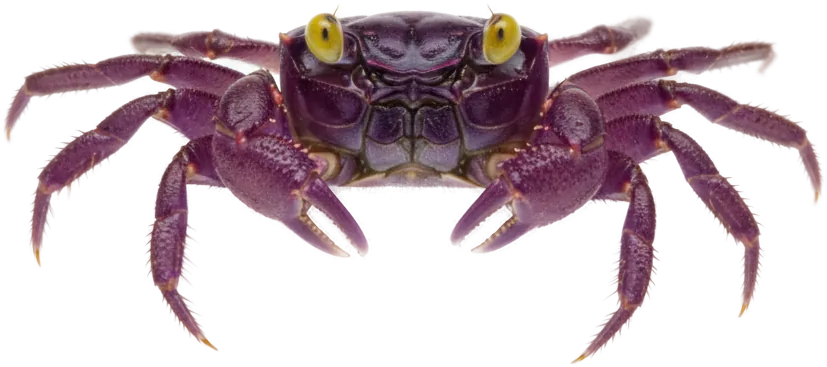
The vampire crab is a tiny, colorful crab that looks like a walking jewel, with a deep purple body, orange claws, and glowing yellow eyes that give it its spooky name. It comes from the island of Java in Asia, and it is one of the most beautiful crabs in the hobby. But there is a very important thing to understand: the vampire crab is mostly a land animal and cannot live underwater.
Vampire crabs need a paludarium with lots of dry land, damp hiding spots, and only a shallow pool of water they can wade into. They breathe air and spend most of their time out of the water, climbing plants and exploring the land area. Unlike some other crabs, they generally live in freshwater land setups rather than needing salt, but the key point is the same: this is not a fully aquatic community animal, and it needs a mostly-land home with a secure lid.
| Care level | Moderate |
| Adult size | 1 in (2.5 cm) leg span |
| Lifespan | 2 to 3 years |
| Temperament | Peaceful but shy |
| Min. tank | 10 gal (38 L) paludarium with lots of land |
| Temperature | 72 to 82 F (22 to 28 C) |
| pH | 7.0 to 8.0 |
| Diet | Omnivore, scavenger |
| Social | Can be kept in a group with plenty of land and hiding spots |
What it is and where it comes from
The vampire crab is a small semi-terrestrial crab from the island of Java in Asia. Its glowing yellow eyes against a purple body earned it the vampire name. Semi-terrestrial means it lives mostly on land, so it needs a very different home from a fish, with plenty of dry space above the water.
Tank and water needs
Vampire crabs need a paludarium of about 10 gallons (38 L) or more that is mostly land, with only a shallow, easy-to-exit pool of water. Keep it warm and humid, around 72 to 82 F (22 to 28 C), with a pH near 7.0 to 8.0. They usually do fine in freshwater land setups without added salt. Add plants, cork bark, and hiding spots, and always use a tight lid since they can climb out.
Diet and feeding
These crabs are omnivore scavengers. Offer them a mix of small foods like sinking pellets, dried and fresh leaves, blanched vegetables, and occasional protein such as bloodworms or small insects. They forage on land and around the shallow water, cleaning up bits of food as they explore.
Tankmates and temperament
Vampire crabs are shy and fairly peaceful, and because they live on land they do not mix into a normal fish tank. They are best kept in their own paludarium, sometimes in a small group if there is enough land and hiding spots for everyone. Do not expect them to be a fully-aquatic community animal swimming with fish.
Moulting and breeding
Like all crabs, vampire crabs moult, shedding their shell to grow and hiding while the new one hardens. They are unusual in that the mother carries her eggs and the babies hatch as tiny fully formed crabs, without a swimming larva stage, which makes them one of the easier crabs to breed in a home setup.
Fun facts
- Vampire crabs get their name from their glowing yellow eyes.
- They live mostly on land and cannot survive fully underwater.
- They need a paludarium with lots of land and only shallow water.
- They usually live in freshwater land setups without needing salt.
- Their babies hatch as tiny crabs, skipping the swimming larva stage.
Frequently asked questions
Can vampire crabs live in a normal fish tank?
No. They live mostly on land and need a paludarium with lots of dry space and only a shallow pool. A fully underwater tank would drown them.
Why are they called vampire crabs?
It is because of their glowing yellow eyes, which stand out against their deep purple body. It is not because they drink blood.
Do vampire crabs need saltwater?
Usually not. They generally do well in freshwater land setups, unlike some other crabs that need brackish (slightly salty) water.
Can I keep more than one vampire crab together?
Yes, they can live in a small group as long as there is plenty of land, plants, and hiding spots so they each have their own space.