Overview
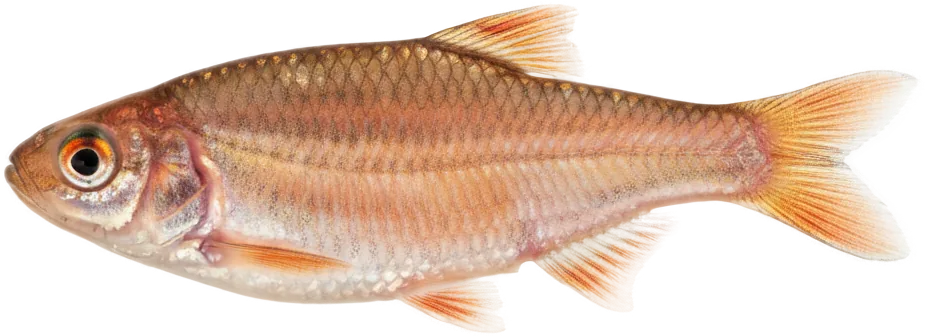
The rosy red minnow is a pinkish-orange colour form of the North American fathead minnow, one of the hardiest little fish you can keep. Sold cheaply as feeder and bait fish, it is often overlooked as a pet, yet a school of them is lively, friendly and beautifully suited to a cool, unheated tank or pond.
These minnows tolerate a huge range of temperatures and water conditions, which is exactly what makes them a great first fish and a natural fit for a temperate pond. Watched rather than fed to something else, they are curious, social and quick to breed.
| Care level | Beginner |
| Adult size | 2-3 in (5-8 cm) |
| Lifespan | 2-4 years |
| Temperament | Peaceful and active |
| Min. tank | 20 gal (76 L) |
| Temperature | 50-78 F (10-26 C) |
| pH | 6.5-8.0 |
| Hardness | 5-20 dGH |
| Diet | Omnivore |
| Schooling | Yes, keep 6 or more |
Water & tank conditions
Rosy reds are extremely hardy cool-water fish that handle anything from near-freezing pond water up to the high 70s F, so they need no heater. They still deserve a clean, cycled, filtered tank rather than the crowded, neglected conditions feeder tanks are known for; good care is what lets their real colour and personality show.
Aquascape & setup
A planted tank or pond with open swimming room, some rocks and cover, and gentle to moderate flow suits them well. They are not fussy about decor, but plants and stones give fry places to hide and give the adults spawning sites in the form of caves and undersides of flat surfaces.
Diet & feeding
Undemanding omnivores that eat flakes, small pellets, frozen foods like daphnia and bloodworms, and will graze algae and nibble vegetables. Feed small amounts once or twice a day; their willingness to eat almost anything is part of what makes them so easy.
Tankmates & temperament
Peaceful, active schooling fish best kept in groups of six or more. Their cool-water needs make them good companions for white cloud mountain minnows, weather loaches and small pond fish, and even young goldfish, though larger goldfish may eventually eat them.
Breeding
Rosy reds breed readily. The male darkens, develops a spongy pad on his back and tubercles on his snout, then claims a cave or the underside of a flat surface, where the female lays eggs that he guards and cleans until they hatch. This easy, watchable breeding makes them a favourite first fish for observing fish behaviour.
Fun facts
- The rosy red is a bright colour form of the plain grey fathead minnow, one of North America's most widespread little fish.
- They are among the toughest aquarium fish, surviving temperatures from near freezing to the high 70s F.
- Breeding males grow a spongy grey pad on the back and bumpy tubercles on the snout, and turn dark to guard their eggs.
- Sold cheaply as feeder and bait fish, they are often underrated as hardy, friendly pets in their own right.
- Fathead minnows are so hardy and consistent that scientists use them as a standard fish in water-quality testing.
Frequently asked questions
Are rosy red minnows good pets or just feeder fish?
Both. They are usually sold cheaply as feeders, but kept in a clean tank or pond they are hardy, active, friendly schooling fish that make an excellent and inexpensive first pet.
Do rosy red minnows need a heater?
No. They are very hardy cool-water fish that tolerate everything from near-freezing water to the high 70s F, so they are ideal for an unheated tank or a temperate pond.
How many rosy red minnows should I keep?
They are schooling fish and are happiest and most colourful in a group of six or more, which also encourages their natural, easily watched breeding behaviour.
Can rosy red minnows live with goldfish?
Young ones can, since they share cool-water needs, but a large goldfish may eventually eat minnows small enough to fit in its mouth, so match sizes carefully.
How long do rosy red minnows live?
Typically 2-4 years. They are short-lived compared with goldfish, but breed so readily that a pond population can sustain itself over time.