Overview
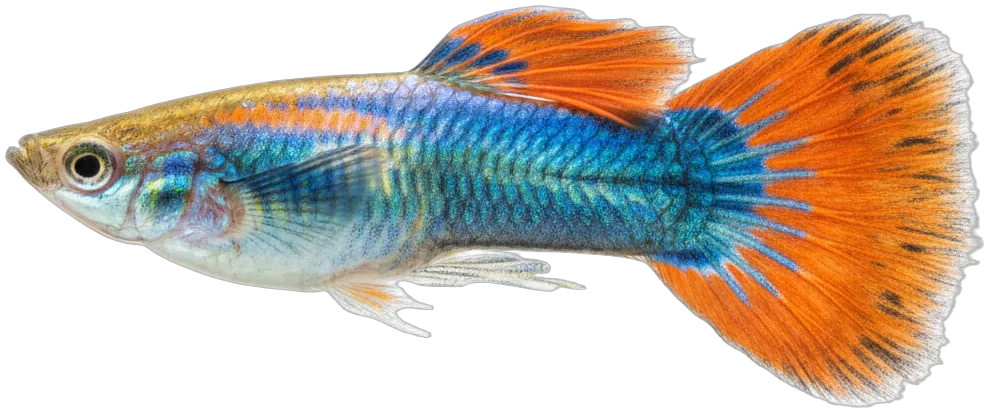
The paradise fish is a striking gourami relative from the rice paddies, ditches, and slow streams of East Asia, including China, Vietnam, and Korea. Its body glows with alternating blue and red-orange stripes, and its fins can stretch out in long, flowing points. Tough and colorful, it has the special claim of being one of the very first tropical fish ever brought to the West to be kept as a pet, back in the 1800s.
Paradise fish belong to a group called labyrinth fish, which means they have a special organ that lets them gulp air from the surface. This lets them survive in warm, still, low-oxygen water where many fish could not. They are hardy and beautiful but also feisty, so they are best kept as a single fish or handled carefully, since two males will often fight.
| Care level | Intermediate |
| Adult size | 3-4 in (8-10 cm) |
| Lifespan | 6-8 years |
| Temperament | Semi-aggressive |
| Min. tank | 20 gallons (76 L) |
| Temperature | 68-79 F (20-26 C) |
| pH | 6.0-8.0 |
| Diet | Carnivore |
| Schooling | No, best kept singly |
A living antique
The paradise fish was one of the first tropical aquarium fish, kept in Europe in the mid-1800s before even the goldfish craze fully took hold. That long history makes it a true classic of the hobby.
The labyrinth lung
Like bettas and gouramis, paradise fish have a labyrinth organ that works a bit like a lung, letting them breathe air at the surface. This is why they can live in shallow, warm, oxygen-poor rice paddies where other fish struggle.
Beautiful but bold
Paradise fish are semi-aggressive, and two males will flare their fins and fight over territory. They are usually kept singly or with carefully chosen tank mates that are not too small, too slow, or too flashy.
Tough in cool water
Because their wild home can get chilly, paradise fish tolerate a wider temperature range than most tropicals and can even handle cooler rooms. This hardiness is part of why early hobbyists found them easy to keep.
Bubble-nest builders
When breeding, a male builds a floating raft of bubbles at the surface and guards the eggs inside it. He fiercely protects the nest, which is a fascinating behavior shared with other labyrinth fish.
Fun facts
- Paradise fish were among the first tropical fish kept by aquarium hobbyists in the 1800s.
- They breathe air using a special organ called a labyrinth.
- Males build floating bubble nests to protect their eggs.
- They are hardy enough to handle cooler water than most tropical fish.
- Two males kept together will usually fight over territory.
Frequently asked questions
Can I keep two paradise fish together?
Two males will usually fight, sometimes seriously. It is safest to keep a single paradise fish, or to house them only in a large, well-planted tank with plenty of hiding spots.
Why does my paradise fish come to the surface for air?
It has a labyrinth organ that lets it breathe air directly. Gulping at the surface is completely normal and part of how it survives in still, warm water.
Are paradise fish good for beginners?
They are very hardy, which is helpful, but their feisty temperament means you have to choose tank mates carefully. That combination makes them an intermediate-level fish rather than a total starter pick.
Do paradise fish need a heater?
They tolerate cooler water than many tropicals, but a stable, gently warm temperature keeps them healthiest. In most homes a heater set to the lower tropical range is ideal.