Overview
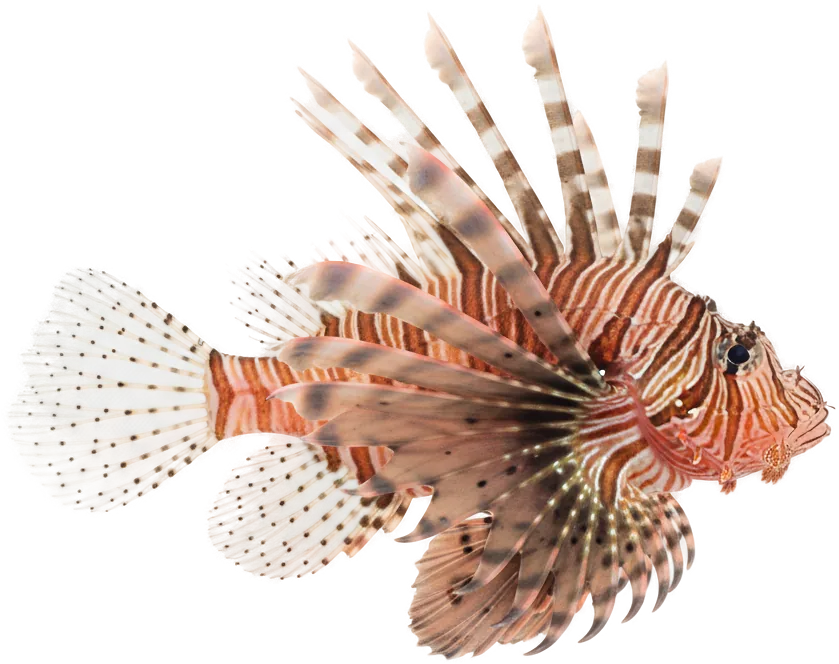
The red lionfish is a slow, graceful predator of Indo-Pacific reefs, wrapped in a fan of long, striped fins tipped with venomous spines. It drifts over the reef at dusk and dawn, spreading its huge pectoral fins to herd small fish and shrimp into a corner before swallowing them in a single fast gulp.
Beautiful but formidable, the lionfish has become one of the ocean's most troubling invaders far from home, and a striking but demanding aquarium fish.
| Care level | Intermediate |
| Adult size | 12-15 in (30-38 cm) |
| Lifespan | 10-15 years |
| Temperament | Predatory |
| Min. tank | 75+ gal (285 L) |
| Water | Saltwater |
| Temperature | 72-80°F (22-27°C) |
| Diet | Carnivore |
| Home aquarium? | Yes, with care (venomous) |
Venom for defence, not attack
A lionfish carries up to 18 venomous spines along its back and fins. The venom is a shield against predators, not a hunting weapon. A sting is intensely painful to a human but very rarely deadly, and the fish would always rather drift away than pick a fight.
How it hunts
Lionfish hunt by stealth, fanning their broad fins to slowly herd prey against rock or into the open, then striking with a lightning-fast snap of the mouth that swallows the victim whole.
An invader in the Atlantic
Released into the western Atlantic, lionfish have spread across the Caribbean and US coast, where they have few natural predators and eat huge numbers of native reef fish. Divers now hold hunts to help protect local reefs.
In the aquarium
Lionfish are hardy and long-lived but will eat any tankmate small enough to fit in their mouth, and their spines demand careful handling during tank maintenance.
Fun facts
- A lionfish carries up to 18 venomous spines, used purely for defence, not for catching prey.
- A sting is extremely painful to people but is very rarely life-threatening.
- It hunts by spreading its huge fins to herd small fish into a corner, then swallowing them whole.
- Lionfish are a serious invasive species in the Atlantic and Caribbean, where they have few predators.
- Despite the drama of their spines, lionfish are slow, calm swimmers that avoid conflict.
Frequently asked questions
Is a lionfish venomous or poisonous?
Venomous. Its spines can inject venom for defence. It is not poisonous to eat once the spines are removed, and lionfish are actually caught as food where they are invasive.
Can you keep a lionfish in an aquarium?
Yes, they are hardy, but with real care: they eat any tankmate that fits in their mouth, and the venomous spines mean cautious handling during maintenance.
Why are lionfish a problem in the Atlantic?
They were released far from their native range, where local fish do not recognise them and few predators hunt them, so they multiply and eat large numbers of native reef fish.
What do lionfish eat?
They are carnivores that hunt small fish and crustaceans, herding them with their fins and swallowing them in a single fast strike.