Overview
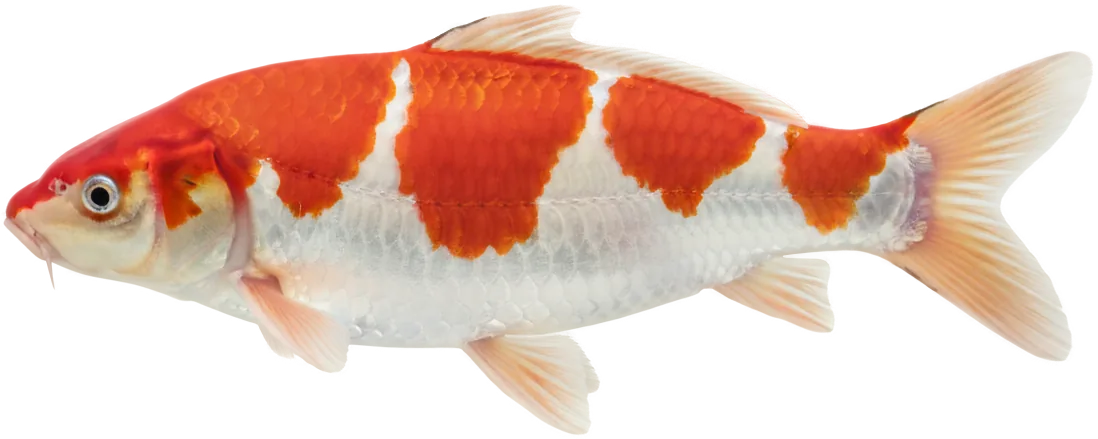
Koi are ornamental carp bred in Japan for their brilliant colours and bold patterns, and they are the classic fish of the garden pond. Names like kohaku, sanke and showa describe their red, white and black markings, prized by keepers and judged at shows around the world.
These are not aquarium fish. Koi grow to the length of your arm, live for decades and need a large outdoor pond with powerful filtration. Kept well, they become tame enough to feed from your hand and can outlive the person who raised them.
| Care level | Intermediate (pond fish) |
| Adult size | 24-36 in (60-90 cm) |
| Lifespan | 25-40 years, sometimes far longer |
| Temperament | Peaceful and friendly |
| Min. tank | Pond only, 1000+ gal (3800+ L) |
| Temperature | 59-77 F (15-25 C), survives near-freezing |
| pH | 7.0-8.5 |
| Hardness | 5-25 dGH |
| Diet | Omnivore |
| Schooling | Social, keep in groups |
Water & pond conditions
Koi are hardy cool-water fish that live outdoors year-round in temperate climates, staying active from about 59-77 F and going dormant near the bottom in winter. They need a large pond (think thousands of gallons), a deep section that will not freeze solid, and strong biological filtration to handle their heavy waste.
Pond setup
Give koi a deep, spacious pond with smooth edges, good aeration and a proper filter and skimmer. They dig and uproot plants, so protect any planting in baskets or a separate bog area. A net or cover helps guard them from herons, cats and other predators.
Diet & feeding
Omnivores with big appetites in warm weather. Feed a floating koi pellet in spring and summer, adding treats like watermelon, lettuce and peas. As the water cools below about 50 F their metabolism slows, and feeding should stop for winter since they cannot digest food in the cold.
Tankmates & temperament
Peaceful, social and best kept in groups of several koi. They mix well with goldfish and other pond fish of similar size, but will hoover up anything small enough to eat. Their gentle, curious nature makes them easy to tame and hand-feed.
Breeding
Koi spawn in late spring as the pond warms, scattering thousands of eggs across plants and spawning mats. Adults eat the eggs and fry, so serious breeders separate them. Colours and patterns vary hugely in the young, and only a few will show the striking markings prized in show koi.
Fun facts
- Koi were developed from ordinary food carp by rice farmers in Japan in the 1800s who noticed and bred colourful individuals.
- They can live for decades, and a famous koi named Hanako was said to have lived well over a century.
- Koi keep growing with the size of their home and can reach three feet in a large pond.
- They have no stomach and, like goldfish, stop feeding in cold winter water.
- Different colour patterns have their own names, such as kohaku (red and white) and showa (black, red and white).
Frequently asked questions
Can koi live in an aquarium?
Only as small juveniles, and even then not for long. Koi grow to two or three feet and live for decades, so they need a large outdoor pond rather than an indoor tank.
How big do koi get?
Adult koi commonly reach 24-36 inches, roughly the length of an arm, which is why they need a pond measured in thousands of gallons rather than a tank.
How long do koi live?
Koi routinely live 25-40 years with good care, and there are famous claims of individuals living for over a century, making them a true lifelong commitment.
Do koi need a heated pond?
No. Koi are cool-water fish that overwinter outdoors in temperate climates, resting near the bottom of a pond deep enough not to freeze solid. You simply stop feeding them in the cold.
What do koi eat?
They are omnivores. Feed a floating koi pellet in warm weather plus treats like peas, lettuce and watermelon, and stop feeding once the water drops below about 50 F.