Overview
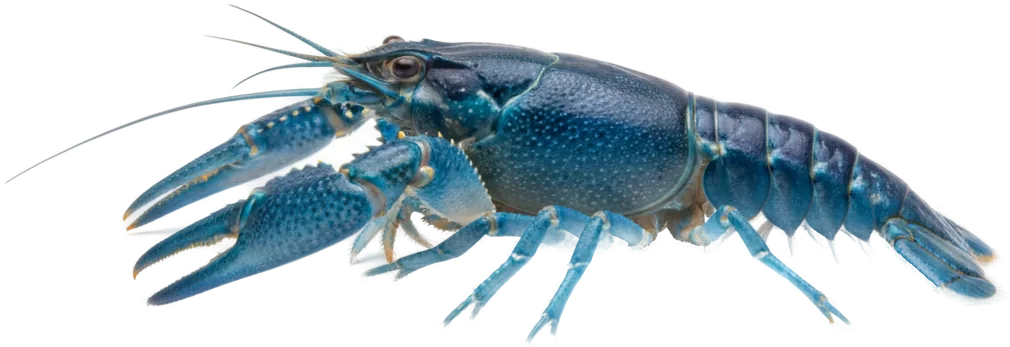
The electric blue crayfish is a showstopper, glowing an almost unreal shade of bright blue. It comes from Florida in the United States, where wild members of its species are usually brown, and the vivid blue form was developed by breeders. It is easy to care for and long-lived, which makes it a favorite, but it is important to be honest about its personality: this is not a peaceful community animal.
As it grows toward five inches long, an electric blue crayfish becomes a bold hunter. It will catch and eat small fish and shrimp, rearrange or uproot plants, and defend its territory. It is best kept alone in its own tank where it can dig, climb, and explore without harming tankmates or being harmed itself. Like all crayfish, it moults to grow, and during that soft-shelled time it hides and is very vulnerable.
| Care level | Easy to keep, but not community safe |
| Adult size | 5 in (13 cm) |
| Lifespan | 5 to 6 years |
| Temperament | Bold and territorial |
| Min. tank | 20 gal (76 L) |
| Temperature | 65 to 78 F (18 to 26 C) |
| pH | 6.5 to 8.0 |
| Diet | Omnivore, scavenger and hunter |
| Social | Solitary, best kept alone |
What it is and where it comes from
The electric blue crayfish is a color form of Procambarus alleni, a crayfish native to Florida in the United States. Wild ones are usually brownish, and the brilliant blue was created through breeding. It is a large, hardy, and long-lived crayfish that is easy to feed but far too bold to trust with small tankmates.
Tank and water needs
Give an electric blue crayfish at least a 20 gallon (76 L) tank with a soft substrate it can dig in, plus caves and hiding spots. It tolerates a wide range from 65 to 78 F (18 to 26 C) and a pH of 6.5 to 8.0. A tight-fitting lid is a must because crayfish are excellent escape artists and will climb out if they can. Avoid copper, which is toxic to it.
Diet and feeding
This crayfish is an omnivore that both scavenges and hunts. Feed it sinking pellets, algae wafers, blanched vegetables, and occasional protein like frozen or fresh meaty foods. It will also catch live prey on its own, which is part of why it is not safe with small fish or shrimp.
Tankmates and temperament
Be honest with yourself here: the electric blue crayfish is best kept alone. It will catch and eat small fish and shrimp, may attack slow-moving fish, and likes to dig up and rearrange plants. It can even fight other crayfish. If you want to watch fish and this crayfish, they should live in separate tanks.
Moulting and breeding
Like all crayfish, it moults, shedding its entire shell to grow a bigger one. Just after moulting its shell is soft and it is defenseless, so it hides until it hardens (this is also when other animals might attack it). It often eats the old shell to reclaim minerals, so leave the empty shell in the tank.
Fun facts
- The electric blue crayfish comes from Florida, where wild ones are usually brown.
- Its stunning blue color was created by breeders.
- It will hunt and eat small fish and shrimp, so it is not community safe.
- It likes to dig and will rearrange or uproot plants.
- It moults to grow and is soft and vulnerable right afterward.
Frequently asked questions
Can I keep an electric blue crayfish with fish?
It is not recommended. As it grows it will catch and eat small fish and shrimp and can harm slow tankmates, so it is best kept alone.
Why does my crayfish keep moving the plants?
Digging and rearranging is natural crayfish behavior. It may uproot plants as it explores and reshapes its territory, so use hardy or potted plants.
Do I need a lid on the tank?
Yes. Crayfish are strong climbers and known escape artists, so a tight-fitting lid keeps them safely inside.
How long do electric blue crayfish live?
They are long-lived for their size, often reaching about five to six years with good care.