Overview
The coelacanth is one of the greatest surprises in science. People believed it had died out with the dinosaurs, more than 65 million years ago, until a living one was caught off South Africa in 1938. That discovery stunned the world and made the coelacanth a true living fossil.
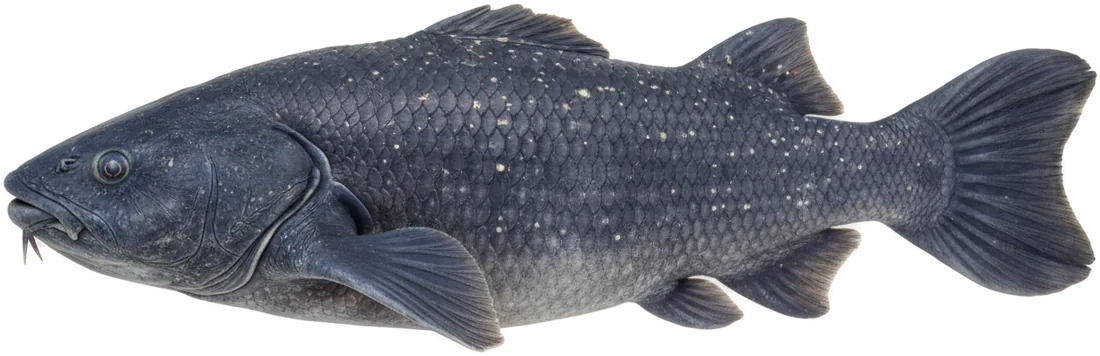
This heavy, deep blue fish can grow around six feet long. It has thick, fleshy fins that stick out from its body and move in a pattern a bit like a walking animal's legs, which is one reason scientists find it so fascinating.
| Where it lives | Deep rocky slopes and underwater caves |
| Range | Off eastern Africa and near Indonesia |
| Adult size | About 6 ft (1.8 m) long |
| Diet | Fish and squid |
| Lifespan | Possibly up to 100 years |
| Depth or habitat | About 500 to 2,300 ft (150 to 700 m) down |
| Keep at home? | No, it is rare, protected, and lives in the deep sea |
Its weirdest feature
The coelacanth has lobed fins, which are chunky and muscular instead of thin like most fish fins. It moves its paired fins in a crisscross pattern, almost like the way a four-legged animal moves its legs when it walks.
Surviving the dark deep
The coelacanth takes life very slowly, which helps it survive in the food-poor deep. It drifts and glides to save energy, has a very slow heartbeat, and may live for many decades, perhaps even close to a hundred years.
How it hunts
It is a calm, drifting hunter that feeds mostly at night on fish and squid. It has a special hinge in its skull that lets it open its mouth extra wide, and a jelly-filled snout organ that senses the weak electricity of nearby prey.
Life in the deep sea
By day, coelacanths rest together in cool, dark underwater caves along steep rocky slopes. At night they come out to feed in the deep. Mother coelacanths carry their young inside their bodies and give birth to live pups after a very long pregnancy.
An amazing fact
The coelacanth belongs to an ancient group of lobe-finned fish that are actually close cousins to the first animals that crawled onto land, which makes it a living window into the deep past.
Fun facts
- It was thought extinct for millions of years until one was caught in 1938.
- Its thick, lobed fins move a bit like an animal's legs.
- It may live close to 100 years.
- It rests in deep caves by day and hunts at night.
- It is a distant cousin of the first animals to walk on land.
Frequently asked questions
Why is the coelacanth called a living fossil?
It looks a lot like coelacanths that lived millions of years ago and was believed extinct until a live one was found, so it seems like a survivor from the ancient past.
Can the coelacanth walk?
No, but it moves its muscular fins in a walking-like pattern as it swims, which is one reason scientists study it closely.
How old can a coelacanth get?
Research suggests it can live a very long time, possibly close to 100 years.
Can you keep a coelacanth?
No. It is rare, protected by law, and lives in the deep sea where it cannot be kept.