Overview
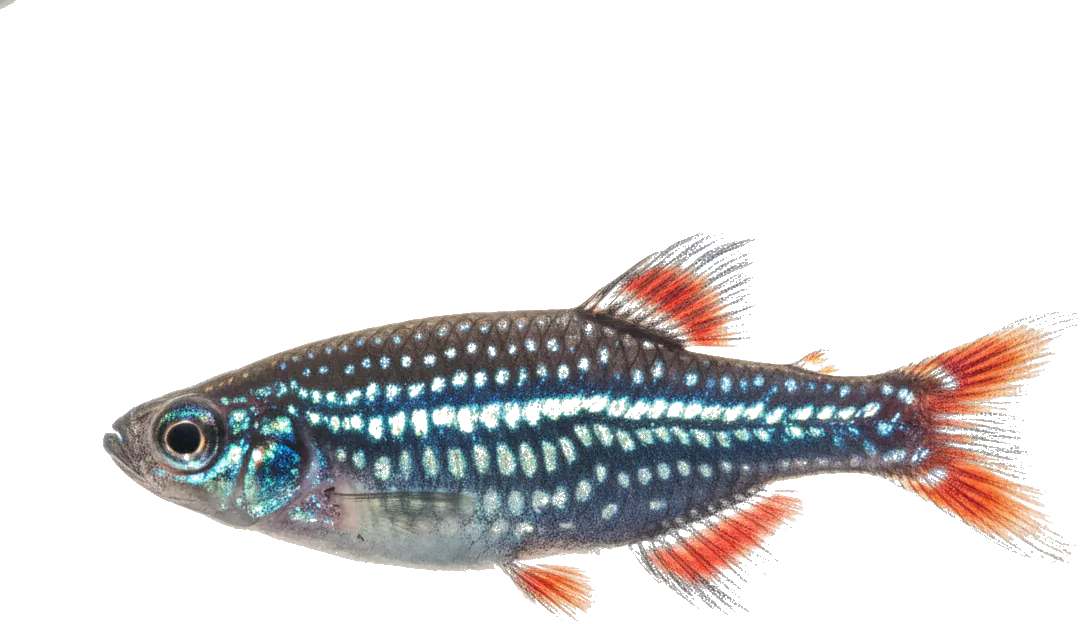
The Celestial Pearl Danio is a jewel of a fish, no bigger than your fingernail, that was only discovered by scientists in 2006 in a small area of Myanmar in Southeast Asia. Its dark blue body is scattered with glittering pearl-white dots like stars in a night sky, and its fins are striped with bright orange-red, which is why it is sometimes called the 'galaxy rasbora'. Despite its tiny size, it is one of the most beautiful nano fish in the hobby.
These little fish live in shallow, spring-fed ponds full of plants. Because they became so popular so fast, wild ones were nearly wiped out, but now most sold in stores are raised on farms, which helps protect the wild ones. They are peaceful and a bit shy, so they do best in a calm, planted tank with plenty of their own kind.
| Care level | Beginner to intermediate |
| Adult size | 0.75-1 in (2-2.5 cm) |
| Lifespan | 3-5 years |
| Temperament | Peaceful and a little shy |
| Min. tank | 10 gallons (38 liters) |
| Temperature | 72-79°F (22-26°C) |
| pH | 6.5-7.5 |
| Diet | Micro-predator that eats tiny live, frozen, and crushed foods |
| Schooling | Yes, keep a group of eight or more |
Water and tank
Celestial Pearl Danios are tiny, so a group can live happily in a 10 gallon tank. They come from cool, shallow, plant-filled ponds, so they like water that is on the cooler side of tropical, clean, and gently filtered. A calm tank without big or boisterous fish suits them best. Steady water conditions and small regular water changes keep these little jewels healthy.
Aquascape and setup
A heavily planted tank is perfect for these shy fish. Lots of plants, mosses, and a few hiding spots make them feel safe enough to come out and show their colors. A gentle filter flow is important because they are weak swimmers and dislike strong currents. Floating plants that soften the light help them relax, and a dark background makes their pearl spots really sparkle.
Diet and feeding
In the wild these danios are micro-predators, hunting tiny creatures in the water. Their mouths are very small, so they need small foods: crushed flakes, micro pellets, and especially tiny live or frozen foods like baby brine shrimp, daphnia, and cyclops. A varied diet with some live food brings out their brightest colors and keeps them in top breeding condition.
Tankmates and temperament
Celestial Pearl Danios are peaceful and easily bullied because they are so small, so choose gentle, tiny tankmates like chili rasboras, pygmy corydoras, and small shrimp. Avoid anything big enough to eat them or fast enough to steal all the food. In a group of eight or more they feel secure, and the males will show off their colors while displaying to each other.
Breeding and eggs
These danios are egg scatterers that lay their eggs among fine plants and mosses, then pay no attention to them. The parents will eat the eggs if they can, so breeders use thick moss or spawning mops to catch them. In a mature planted tank a few babies may quietly appear on their own. The tiny fry need very small foods like infusoria to survive.
Fun facts
- Celestial Pearl Danios were only discovered by scientists in 2006, making them a recent find.
- They are nicknamed 'galaxy rasboras' because their pearly spots look like stars.
- Fully grown, they are only about an inch long, roughly the size of your fingernail.
- Wild ones became rare fast, so most in stores today are raised on farms to protect wild ponds.
- The males are more colorful and often 'spar' by facing off and flashing their fins without hurting each other.
Frequently asked questions
How small are Celestial Pearl Danios?
Very small, only about three quarters of an inch to one inch long. They are true nano fish, perfect for small planted tanks.
Can they live with betta fish or bigger fish?
It is risky. They are tiny and shy, so big or fast fish may eat them or steal their food. Gentle nano tankmates like chili rasboras and small shrimp are much safer.
How many should I keep?
Keep at least eight, and more is better. In a good group they feel safe, come out into the open, and the males show off their brightest colors.
What do they eat?
Very small foods, because their mouths are tiny. Crushed flakes, micro pellets, and small live or frozen foods like baby brine shrimp and daphnia are ideal.