Overview
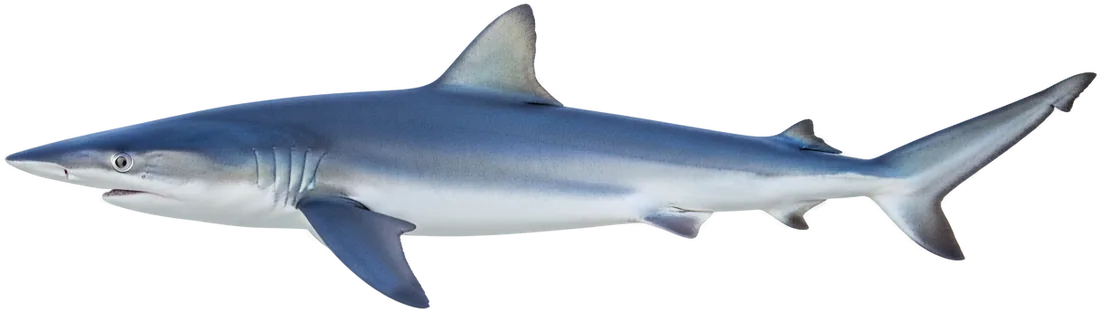
The blue shark is one of the most beautiful sharks in the sea, with a slim, graceful body and a deep, brilliant blue back that fades to snowy white on the belly. It has long, wing-like pectoral fins, a pointed snout, and large eyes, all suited to a life spent gliding through the open ocean. Blue sharks are found in more parts of the world than almost any other shark.
Blue sharks are true ocean wanderers. They ride the great ocean currents on incredibly long journeys, and some have been tracked crossing entire oceans, swimming thousands of miles. They mainly eat squid and small fish, gliding slowly to save energy and then speeding up when it is time to feed. Sadly, blue sharks are also among the most heavily fished sharks in the world.
| Where it lives | Open ocean, usually far from shore in cooler upper waters |
| Range | Temperate and tropical seas worldwide, one of the most widespread sharks |
| Adult size | Commonly 6 to 10 ft (1.8 to 3 m) |
| Diet | Squid, small schooling fish, and sometimes seabirds |
| Lifespan | Around 20 years |
| Depth or habitat | Open water from the surface down to several hundred meters |
| Keep at home? | No, a wide-roaming open-ocean shark |
A shark of true blue
The blue shark really is blue, one of the few animals with such a rich blue color. Its back is deep blue, its sides are lighter, and its belly is white, giving it perfect countershading to hide in the open ocean. Its slim body and long, slender fins let it glide gracefully with very little effort, which is important for an animal that swims such long distances.
Ocean marathon swimmer
Blue sharks take some of the longest journeys of any shark. By riding ocean currents, they travel enormous distances, and tagged blue sharks have been recorded crossing whole oceans. These long trips follow the seasons, the water temperature, and the movements of their prey. Few sharks roam as far and wide across the planet as the blue shark does.
Squid hunter
Blue sharks feed mostly on squid and small schooling fish. They often cruise slowly to save energy, then use quick bursts of speed to snap up prey when they find a good meal. They will feed both near the surface and down in deeper, darker water, and they sometimes gather where food is plentiful, taking turns in a feeding frenzy.
Are they dangerous?
Blue sharks are curious and will sometimes come close to divers, but they are generally not aggressive, and bites on people are very rare. They spend almost all their time far out in the open ocean, away from beaches and swimmers. Most encounters are calm, and divers describe them as elegant and graceful rather than frightening.
Heavily fished
Even though blue sharks are common and found nearly everywhere, they are caught in huge numbers, both on purpose and by accident on lines meant for other fish. Millions are taken from the ocean every year, mostly for their fins. They are currently listed as near threatened. Because they are so widespread, careful fishing limits across many countries are needed to keep their numbers healthy.
Fun facts
- Blue sharks are among the most widespread sharks, found in oceans all over the world.
- Some have been tracked swimming across entire oceans on journeys of thousands of miles.
- Their deep blue color is rare among animals and helps them hide in open water.
- They feed mostly on squid and small fish.
- Blue sharks are one of the most heavily fished sharks in the world.
Frequently asked questions
Why is it called a blue shark?
Because it really is a brilliant deep blue on its back, one of the few animals with such a rich blue color.
How far do blue sharks travel?
Very far. Some have been tracked crossing whole oceans, riding the currents on journeys of thousands of miles.
What does it eat?
Mostly squid and small schooling fish, and sometimes seabirds.
Is it dangerous?
Blue sharks are curious but rarely aggressive, and bites on people are very uncommon because they live far out in the open ocean.
Are blue sharks endangered?
They are listed as near threatened because so many are caught by fishing, so they need careful protection.